csxq0605/manyselves
ManySelves: A Recoverable Runtime for File-Defined Agent Teams
A recoverable local runtime for file-defined agent teams, with a bundled power-distribution safety reporting capability.
Overview
ManySelves is a recoverable local runtime for file-defined agent teams: identities, skills, tasks, contracts, and workflows are declared in Markdown, YAML, and JSON Schema, compiled into a frozen plan, and executed by a stateless kernel. Its bundled power-distribution safety reporting capability splits work so that code handles structure (grouping, citations, gap classification, reconciliation, assembly) while the model makes the professional judgments in a judgment ledger, and revisions produce a new version under the same run, reopening only the modules whose facts changed.
Built at Hangzhou Yuanxi Technology (Jun – Sep 2026), where I designed and implemented its runtime kernel and capability packages.
README
Copied from csxq0605/manyselves at b97aecd on 2026-11-09.
One runtime. Many selves.
A recoverable local runtime for file-defined agent teams, with a bundled power-distribution safety reporting capability.
Philosophy
How an agent team divides its work belongs in files, not in another bespoke app.
Swap the identity, skill, task, and workflow definitions and the same runtime becomes a different team. The runtime owns only the generic, durable parts: conversations, files, scheduling, checkpoints, providers, and artifacts. Who does what lives in a Capability’s definition files.
One runtime. Many selves.
Design principles
-
File-defined
Agents, tasks, tools, contracts, workflows, and recovery policies are declared in Markdown / YAML / JSON Schema. Flow lives in files, not in privateif/fororchestration. -
One stateless kernel, one compile-and-execute semantics
Plan + State + Event → New State + EffectsThe kernel does not know providers, report chapters, or domain fields, and Capabilities do not build a second state machine.
-
Domain code belongs to the Capability
Domain models, deterministic rules, prompts, tools, rendering, and delivery live in the Capability; the generic layer only schedules them. -
Structure for code, judgment for the model
What the input structure determines (grouping, citations, checks, assembly) is done by code. Professional judgment is left to the model; code checks only its citations and structure. -
Recoverable and traceable
A run can wait and resume after an interruption. Conversations, tool results, events, and artifacts are kept on disk. -
Users talk to Main only
Authors, reviewers, and the chief editor work on one timeline behind Main.
Full positioning: docs/PROJECT_POSITIONING.md
and AGENTS.md.
System shape
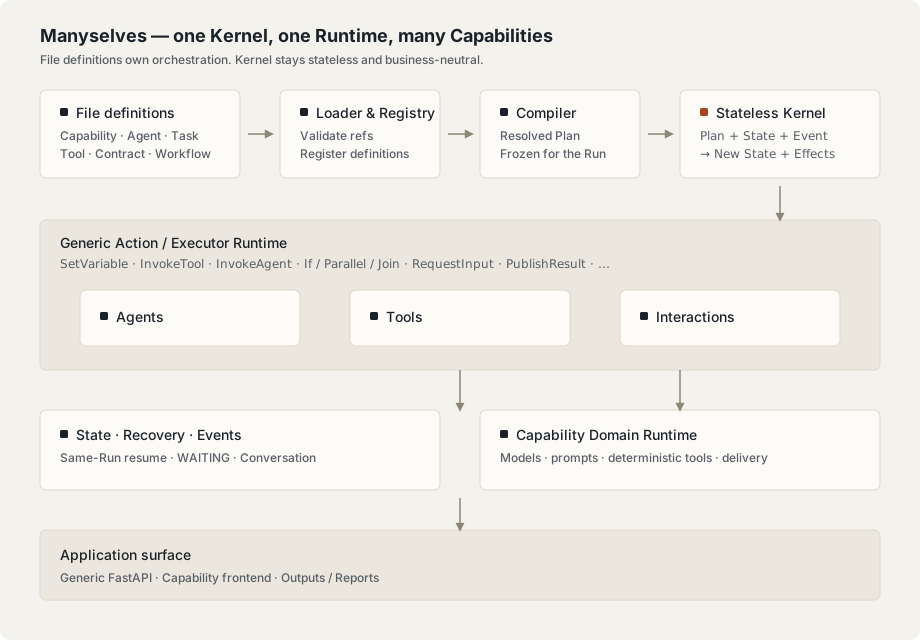
Markdown / YAML / JSON Schema / Python Tool references
                         │
                         ▼
              Definition Loader & Registry
                         │
                         ▼
                  Workflow Compiler
                         │
                         ▼
             Resolved Plan + Stateless Kernel
                         │
                         ▼
           Generic Action / Executor Runtime
                         │
          ┌──────────────┼──────────────┐
          ▼              ▼              ▼
        Agents          Tools       Interactions
          │              │              │
          └──────────────┼──────────────┘
                         ▼
              State / Recovery / Events
                         │
                         ▼
        FastAPI / Capability Frontend / Outputs
Bundled Capability: power-distribution safety report
distribution_reporting turns the assessment tables, site photos, knowledge
base, and report template in a project’s Inputs/ into a power-distribution
safety assessment report (Word plus an evidence and source index). It shows
what the runtime can host; it is not the runtime’s boundary.
How a full report runs
| # | Stage | Done by |
|---|---|---|
| 1 | Read the tables into checkpoint records and an evidence index; chapter 2 section numbers and titles come only from the assessment summary table | code |
| 2 | Read photos; photos only corroborate the tables, and the table text wins for the same reading | model (parallel) |
| 3 | Judgment ledger: judge each checkpoint by group, every row citing its records; evidence gaps are classified by code | model + code |
| 4 | Cross-module relations: authors propose them, code routes and checks them by structure | model + code |
| 5 | Review: module review (including same-kind rows) and cross-module review in parallel; revise only on blocking findings, with code re-checks between rounds | model + code |
| 6 | Settle the ledger, build the storyline and gap entries, attach photos to judgment rows | code |
| 7 | Writing: chapter 2 sections written once from the ledger; the chief editor writes chapters 3 and 1 | model (parallel) |
| 8 | Joint review: one per writer, carrying only its sections, rows, cited records, and the chapter 1/3 entries on those rows; a judgment-row change is carried by code to every place that cites it | model + code |
| 9 | Reconcile, assemble, render the DOCX and the evidence and source index | code |
Chapter 4 (special issues) depends only on whether Inputs/ holds the
matching special files. Where evidence is missing the report says so.
Report operations Main can run
| You say | Operation |
|---|---|
| Write a new report from the current inputs | full_report |
| Change a section or module, or revise for updated inputs | revise_report: the next version under the same run id; unaffected parts are reused |
| Re-distill the writing Skills from the template | extract_skills, then publish_skills after confirmation |
| Turn existing Markdown into Word | render_existing |
| Continue a stopped or failed run | resume_run |
See the Operation Manual (Chinese) for phrasing and parameters.
What is in this repository
| Path | Contents |
|---|---|
manyselves/kernel/ |
Stateless kernel: definitions, contracts, pure transitions, ports |
manyselves/runtime/ |
Generic agent/tool/conversation/interaction/recovery/event execution; providers |
manyselves/definitions/ |
Standard definition library shared by Capabilities |
manyselves/capabilities/ |
Capabilities: distribution_reporting, plus parameter_adjustment and checklist_review that exercise the generic path |
manyselves/application/ |
Generic Capability/Workflow/Run lifecycle |
manyselves/webapi/ |
Generic FastAPI |
manyselves/templates/ |
Agent identity and report Skill documents |
frontend/ |
React product frontend for the reporting Capability |
frontend-contract/ |
OpenAPI contract used by the frontend |
desktop/ |
Electron shell |
deploy/, deployment/, scripts/ |
Compose deployment, offline deployment, start and maintenance scripts |
tests/ |
Kernel, runtime, Capability, API, and deployment tests |
docs/ |
Operation, running, configuration, positioning (index) |
Quick start
Requirements: Python 3.12+, uv, Node.js 22+, and an API key for at least one supported provider.
git clone https://github.com/csxq0605/manyselves.git
cd manyselves
uv sync

cp manyselves.config.example.yaml manyselves.config.yaml
cp .env.example .env              # set the admin password; never commit .env

cd frontend && npm ci && npm run build -- --base / && cd ..
uv run python run_web.py --host 127.0.0.1 --port 9090 --data-dir <workspace>
Open http://127.0.0.1:9090/, sign in with the admin account from .env, set
a provider and key in model settings, and tell Main what you want.
On Linux/macOS ./start.sh also works (it builds the frontend when needed).
Docker, multi-account, and service deployment: Running;
offline packaging: Offline deployment.
Docs
| Purpose | Document |
|---|---|
| Operation manual | docs/OPERATION_MANUAL.md |
| Run locally | docs/RUN_LOCAL.md |
| Running and deployment (Docker, multi-account, services) | docs/RUNNING.md |
| Offline packaging and remote deployment | docs/OFFLINE_PACKAGING_REMOTE_DEPLOYMENT.md |
| Configuration | docs/CONFIGURATION.md |
| Product and architecture positioning | docs/PROJECT_POSITIONING.md |
| Repository rules (dev / agents) | AGENTS.md |
| Docs index | docs/README.md |
License
MIT. See LICENSE.